There is a certain type of player that Purdue basketball fans will never forget. Not just their ability to score the most points or who won the most awards, but the ones who stayed, responded to adversity every time it arose, embraced the grind, and left West Lafayette better than they found it.
Those traits are what connect every great group in Purdue history. Ranked across three criteria—regular season success, postseason results, and program impact—these five trios represent the gold standard of Boilermaker basketball. Adversity is also woven through each ranking, because at Purdue, how a team responds when things don’t go their way is just as important as when it does.
No. 5: The “Three Amigos” - Troy Lewis, Todd Mitchell, and Everette Stephens
Credit: Journal & Courier
Regular season success is where this triad built its legacy. Troy Lewis, Todd Mitchell, and Everette Stephens won back-to-back Big Ten Conference championships as juniors and seniors in 1987 and 1988, going 96-28 over four seasons, helping Gene Keady establish Purdue as a genuine national power. Going 29-4 and winning the outright conference title by three games during the 1987–88 season, the “Three Amigos” helped Purdue earn the No. 1 seed in the Midwest Region of the NCAA Tournament for the first time in program history. Lewis averaged 17.9 points, 4.6 rebounds, and five assists per game that season, and currently ranks sixth among the program’s all-time leading scorers with 2,038 points. Mitchell was a two-time first team All-Big Ten forward who contributed 15.7 points and 5.8 rebounds per game. Stephens ran the offense with precision, averaging 5.5 assists per game and is tied for fourth all-time in program history in career assists with 481.
The adversity this group faced was more subtle than the dramatic injuries or losses that plagued other groups on this list, but it was still real. As juniors in 1987, they carried Purdue through a grueling Big Ten only to be blown out by Michigan in the regular season finale, handing Indiana a share of the title and the No. 1 seed in the Midwest Region. Indiana went on to win the national championship while Purdue was seeded No. 3 in the East Regional, eventually losing to Florida in the second round. The sting of that loss, though, undoubtedly fueled what became a dominant senior season.
Their postseason ceiling is what keeps this trio ranked fifth. Their inability to get past fourth-seeded Kansas State in the Sweet 16 in 1988 was a disappointing end to their Purdue careers. Gene Keady’s squad led by nine at halftime, but even with Stephens’ 20 points and nine assists, the Boilermakers came up short in a 73-70 loss. Their importance to the program cannot be overstated, as they are the three who proved Keady could recruit and develop talent at a national level. This group laid the foundation for everything that followed in West Lafayette, and they are forever remembered together, being inducted into the Purdue Intercollegiate Athletic Hall of Fame in 2010 alongside Keady himself.
No. 4: Joe Barry Carroll, Arnette Hallman, and Keith Edmonson
Credit: Kokomo Tribune
Before the 2023–24 season, this trio held Purdue’s most recent Final Four appearance from the 1979–80 season. For Boilermaker fans who have spent years watching different squads knock on the door in March, the 1980 class represents one of the few times anyone has actually answered.
Joe Barry Carroll was one of the most dominant players in program history. He currently sits first in blocks (349), second in total rebounds (1,148), and third in scoring (2,175) for his career in the Old Gold and Black. As a senior under first-year head coach Lee Rose, he earned consensus first team All-American honors, averaging 22.3 points and 9.2 rebounds, leading the Boilermakers to a 23-10 record. Arnette Hallman was an explosive forward who owns one of the greatest moments in Mackey Arena history, hitting a game-winning shot against No. 1-ranked Michigan State in 1979. Keith Edmonson earned AP honorable mention All-American recognition during the 1981–82 campaign as a productive and physical scoring guard.
This trio didn’t really have any dramatic injuries or heartbreaking near-misses that define the other groups on this list. As Carroll himself said years later, their Final Four run was “kind of a surprise party - nobody expected us to go.” They were a well-coached, disciplined team that overachieved relative to preseason expectations and peaked at exactly the right time. Their absence of adversity is not a knock, it simply means that this team executed well when it mattered the most. The Final Four 67-62 loss to UCLA at Market Square Arena in Indianapolis came against a superior Bruins squad, and the Boilermakers competed hard to the end.
In terms of program importance, this group sits in a unique place. As one of three teams to reach the Final Four, they are part of the measuring stick every Purdue squad tries to live up to. That kind of legacy does not fade.
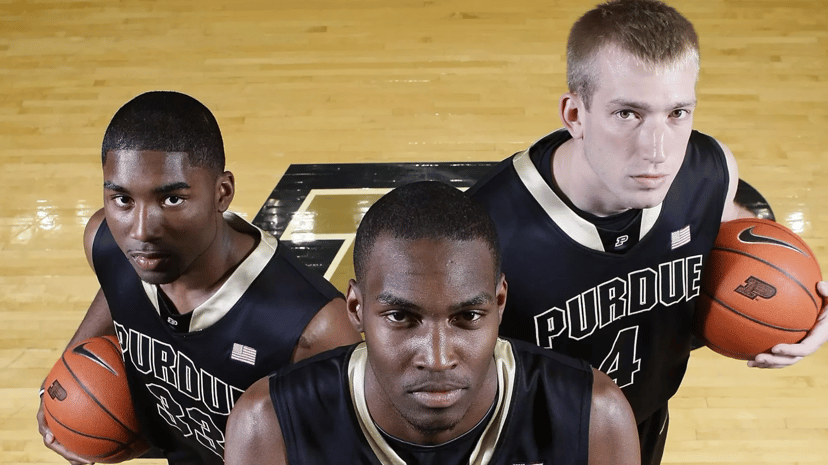
No. 3: The “Baby Boilers” - Robbie Hummel, JaJuan Johnson, and E’Twaun Moore
Credit: Purdue Athletics
The Baby Boilers arguably faced more adversity than any other trio, and almost no one responded better to it than them.
Robbie Hummel, JuJuan Johnson, and E’Twaun Moore arrived in West Lafayette together in 2007 as the foundation of Matt Painter’s first great recruiting class and spent four seasons building one of the most consistent programs in the Big Ten. They finished no lower than third in the Big Ten during the regular season, won the 2009 Big Ten Tournament, earned a share of the 2009–10 Big Ten regular season title, and made four consecutive NCAA Tournament appearances, winning at least one game in each appearance and advancing to the Sweet 16 twice. They finished with a program-record 107 wins at the time of their graduation.
Moore became just the second Boilermaker ever to earn All-Big Ten honors four times, being named second team in 2008 and 2009 and first team in 2010 and 2011. He was also an honorable mention AP All-American in 2010 and 2011, a Wooden Award finalist as a senior, and is fourth among the program’s all-time leading scorers with 2,136 career points. Johnson ranks third with 263 career blocks at Purdue, has a program-best 11.5 career defensive win shares, and earned a spot on the Big Ten All-Defensive Team three times. He was first-team All-Big Ten in 2009, second-team All-Big Ten in 2010, and returned to first-team recognition in 2011, while taking home Big Ten Defensive Player of the Year, Big Ten Player of the Year, and consensus All-American honors. Hummel, a three-time first-team All-Big Ten selection (2008, 2010, 2012) and third-team All-Big Ten selection (2009), averaged 14 points, 6.8 rebounds and shot 38.9% from three-point range over his career. He was on a trajectory to become an All-American and the greatest player to don the university’s name across his chest.
Then came the injuries. During the 2009–10 season on a chilly, late February night in the Twin Cities, No. 3 ranked Purdue edged Minnesota 59-58 but lost the Valparaiso, Ind. native in the process when he tore his right ACL. He had scored 11 points in 12 minutes before the injury. The Boilermakers, who just lost their most versatile weapon, went on to win two more games in the regular season, went 1-1 in the Big Ten Tournament, and advanced to the Sweet 16 in the Big Dance, but Hummel’s untimely injury left Boilermaker fans wondering what could have been. The following season, Hummel re-tore the same ACL in a preseason practice, crushing the hopes of many for the season to come.
Again, though, Purdue refused to fold, finishing second behind No. 1 Ohio State in the regular season conference standings and winning its first round matchup in the NCAA Tournament. The fact that this group still achieved what it did while losing their star player to the same devastating injury twice is an impeccable display of resiliency, and one that solidified their place as a top trio both on the court and in the hearts of Boilermaker fans.
The reason this triad does not rank higher is because their true ceiling as a group was never really tested. Multiple Final Fours with at least one national championship game appearance were certainly plausible outcomes given how good those teams were at full strength. That what-if factor here is enormous; something Purdue fans will talk about forever. But, a class that won 107 games, built the foundation for the Painter Era, and refused to let back-to-back ACL injuries derail four years of hard work and sacrifice deserves enormous credit, and a top-three spot in this list.
No. 2: Rick Mount, Herm Gilliam, and Billy Keller
Credit: Dean Bentley
Every program has a moment that defies its identity. For Purdue basketball, it’s March 1969, and this is the trio that made it happen.
In the regular season, Rick Mount, Herm Gilliam, and Billy Keller were dominant. They rolled to a Big Ten championship, finishing 13-1 in conference play, led the nation in scoring at 93.0 points per game, and produced one of the greatest individual seasons in college basketball history. Mount averaged 33.3 points per game as a junior while shooting better than 50 percent from the field, even without a 3-point line. Gilliam averaged 15.8 points and 8.5 rebounds as a co-captain and went on to be selected eighth overall in the NBA Draft. Keller, listed at just 5-foot-10, won the Frances Pomeroy Naismith Award as the nation’s best player under 6 feet tall and averaged 14.1 points per game for his career.
Their postseason was historic. Purdue had never played in the NCAA Tournament before 1969. In its first appearance, this trio carried the Boilermakers all the way to the national championship game. Mount hit a buzzer-beating overtime jumper against Marquette to reach the first Final Four in program history, then torched North Carolina for 36 points in a 92-65 semifinal blowout. Along the way, they did something no Purdue team had ever done, and until 2024, no team would do again.
Adversity defined the championship game in ways that still sting more than 50 years later. Gilliam missed the first game of the tournament with a sprained ankle and was not fully healthy for the title game. Keller suffered a knee injury in the final minutes of the North Carolina semifinal and had to receive a painkiller injection just to play against UCLA. Perhaps most critically, 7-foot center Chuck Bavis separated his shoulder in the regional game against Miami of Ohio and was lost for the rest of the tournament.
Bavis had been one of the few players in the country who could challenge Kareem Abdul-Jabbar. Without him, two key contributors playing at less-than-full strength, and a 12-of-36 shooting night and 28 points from Mount, plus 37 points and 20 rebounds for Abdul-Jabbar, UCLA won 92-72. The Bruins might’ve prevailed regardless of the circumstances, considering the 1969 title was their third straight, fifth in the last six seasons, and fifth of what would become 10 national championships in a 12-year stretch. However, Boilermaker fans have spent almost six decades wondering what a healthy Purdue team might have done on college basketball’s biggest stage.
In terms of program importance, it’s hard to match what this group built. They created Purdue’s tournament identity, established Mackey Arena as one of college basketball’s greatest venues, and set the standard of excellence that every subsequent squad has chased. This trio gave the program something to believe in for generations.
No. 1: Braden Smith, Fletcher Loyer, and Trey Kaufman-Renn
Credit: Michael Conroy
The case for this trio at No. 1 begins with a simple fact: they won more games than anyone who came before them. The 117 career wins logged by Braden Smith, Fletcher Loyer, and Trey Kaufman-Renn are the most by any senior class in Purdue history and third-most in Big Ten Conference history.
They won Big Ten regular season titles during their freshmen and sophomore seasons, and Big Ten Tournament championships as freshmen and seniors. Their postseason body of work is the deepest of any Purdue senior class since 1969. They reached the national championship game in 2024, eventually falling to a UConn team that will go down as one of the best teams in NCAA history. As a No. 4 seed in 2025, they reached the Sweet 16 before losing 62-60 at Lucas Oil Stadium to Houston, the eventual national runners-up. Then in their final trip to the Big Dance as a No. 2 seed, they took out Queens (NC), Miami (FL) and Texas en route to the Elite 8, where they fell 79-64 to a very talented No. 1 seed Arizona in San Jose.
It would be incomplete not to acknowledge Zach Edey, the two-time Naismith Award winner who played alongside this group for two seasons. The 2024 national championship game appearance, which is the crown jewel of this era, was built on Edey’s back as much as anyone’s. His partnership with Smith, Loyer, and Kaufman-Renn was central to what made this the greatest era in Purdue basketball history.
They were the preseason No. 1 in the AP poll, dropped no lower than 18, and finished No. 6 in the final poll. During his senior year, Smith broke the Big Ten’s career assist record – previously held by Cassius Winston of Michigan State – and went on to break the all-time NCAA career assist record with 1,103, passing Bobby Hurley’s mark of 1,076 in the first round of the NCAA Tournament. He was twice named Big Ten Player of the Year and was a consensus All-American as a junior and senior. Loyer set the Purdue program record with 309 career 3-pointers, surpassing Carsen Edwards’ mark of 281. Kaufman-Renn averaged 20.1 points per game as a junior and was the team’s primary scoring option their final two seasons in West Lafayette.
Adversity ran through the entire arc of this class. As a No. 1 seed in 2023, they suffered one of the worst and most stunning upsets in NCAA Tournament history, losing in the first round to No. 16 Fairleigh Dickinson. Their junior season ended with a gut-wrenching Sweet 16 loss to Houston, when a late inbounds play broke a tie with less than a second remaining. Then came their senior year: a promising start unraveled over the final stretch of the regular season, dropping the Boilermakers to a No. 7 seed in the Big Ten Tournament and momentum pointing in the wrong direction.
What happened next is a perfect showing of just how great this group, and really the program as a whole, truly are. They beat Northwestern, Nebraska, UCLA, and Michigan in consecutive days to win the second Big Ten Tournament championship of their careers. After rolling through Queens in the Round of 64 and Miami in the Round of 32, they escaped Texas in the Sweet 16. With the game tied and time running out, Kaufman-Renn tipped in a missed Smith layup with 0.7 seconds left to beat the Longhorns 79-77. Every time the door appeared to be closing, these three found a way to push it back open.
What elevates this class above all others is the combination of sustained excellence and deliberate actions. In the era of the transfer portal and NIL, Smith, Loyer, and Kaufman-Renn chose Purdue completely, fully, and without reservation for their entire careers. They earned their degrees. They shattered records. They won more games than anyone else in program history. And they did it the Purdue way.
What Being a Boilermaker Means
The five trios on this list span more than 50 years of Purdue basketball. They played in different eras for different coaches, and against wildly different competition. But, they share something that no ranking system can fully capture: they understood what it meant to be a Boilermaker. They stayed when they could have left. They competed when it would have been easier to fold. And they left Mackey Arena better than they found it. That has always been the standard in West Lafayette, and these five trios set it higher than anyone else.
Frequently asked
Quick answers.
The useful details, answered clearly and without the digging.
01
Who are the greatest trios in Purdue basketball history?
This ranking puts Braden Smith, Fletcher Loyer, and Trey Kaufman-Renn at No. 1, followed by Rick Mount, Herm Gilliam, and Billy Keller at No. 2, the "Baby Boilers" (Robbie Hummel, JaJuan Johnson, and E'Twaun Moore) at No. 3, Joe Barry Carroll, Arnette Hallman, and Keith Edmonson at No. 4, and the "Three Amigos" (Troy Lewis, Todd Mitchell, and Everette Stephens) at No. 5. The trios are ranked across regular season success, postseason results, and program impact.
02
How many career wins did Braden Smith, Fletcher Loyer, and Trey Kaufman-Renn have at Purdue?
The trio logged 117 career wins, the most by any senior class in Purdue history and the third-most in Big Ten Conference history. Along the way, they reached the 2024 national championship game, made the 2025 Sweet 16, and went to the Elite 8 in their final season, winning two Big Ten Tournament titles and two Big Ten regular season titles.
03
Did Braden Smith break the NCAA career assists record?
Yes. Braden Smith broke Bobby Hurley's all-time NCAA Division I career assists record during the first round of the 2026 NCAA Tournament against Queens University, recording his 1,077th career assist to pass Hurley's mark of 1,076. Smith already held the Big Ten career assists record and was a two-time Big Ten Player of the Year and consensus All-American.
04
Who is the best trio in Purdue basketball history?
According to this ranking, the best trio in Purdue basketball history is Braden Smith, Fletcher Loyer, and Trey Kaufman-Renn. The group won 117 games, the most by any senior class in program history, reached the 2024 national championship game alongside two-time Naismith winner Zach Edey, and chose to stay all four years at Purdue in the transfer portal and NIL era. Smith also broke the NCAA all-time career assists record during their senior season. They edged out legendary trios like Rick Mount's 1969 national runner-up squad and the "Baby Boilers" for the top spot.